At this time of year I am seeing a lot of people post their reading lists from the current year, so feel I need to follow suite. Every year I say I want to read more, but find it hard to do so. The pandemic has given more opportunity to just sit at home, or in the garden and read. Looking back, having set myself the goal of reading one book a month, I can feel pretty satisfied.
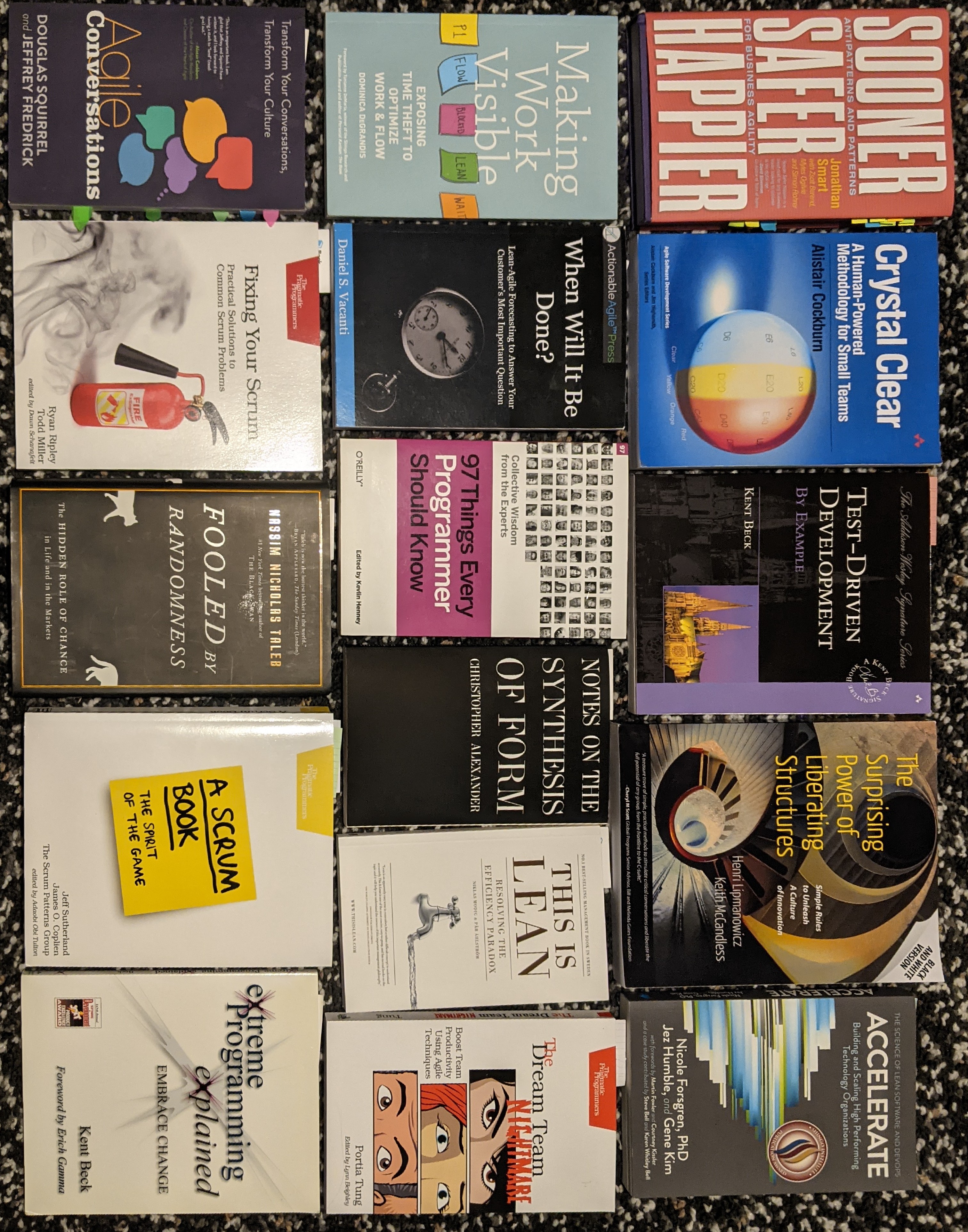
Sooner Safer Happier - Jonathan Smart (2020)
This book has been recommended by Chris Combe, which does a good job of explaining how companies should approach agile transformations. I love that it explains it is a journey the whole organisation should go on together, and not just a project for IT. The authors have come from a finance background with Barclays, talk about regulatory issues, highlighting that there are no excuses for us not to improve our way of working.
Crystal Clear - Alistair Cockburn (2004)
Over 20 years ago Cockburn was hired by IBM to create a lightweight software development process. With no prior experience he traveled the world interviewing teams asking two questions. What made your project successful? And, would you work like this again? The research resulted in the Crystal framework, which will sound familiar to anyone who has studied agile practices - small teams, close collaboration, frequent delivery and feedback, reflection and improvements.
Test Driven Development - Kent Beck (2002)
After attending some of the O’Reilly live trainings with Uncle Bob I spent a weekend re-reading this classic. The example used to start the book reminds me that you progress can be made in small steps, as long as you are making progress.
The Surprising Power of Liberating Structures - Lipmanowicz & McCandless (2014)
This book contains a set of structures which will transform your meetings, getting everyone engaged. All of the content for the book is also available on their website, liberatingstructures.com
Accelerate - Forsgren, Humble & Kim (2018)
It had been on my list since it was first published, as I’ve heard so many good things about it, and it does not disappoint. As always, it highlights that teams following the agile/dev ops processes for the right reasons find huge benefits, while those doing them because they are the current trend or management asking them to, make little progress, or even go backwards.
Making Work Visible - Dominica DeGrandis (2017)
In the first part of this book DeGrandis talks of five time thieves we encounter in our daily work. The remainder uses Kanban to highlight how these thieves are affecting our work. Lots of nice Kanban examples, and based on this I’ve started to use my own physical board tracking my tasks.
When Will It Be Done - Daniel Vacanti (2020)
Vacanti is the master of agile metrics. This book contains a number of tools that can be used for tracking and estimating projects. However, my biggest take away was that estimates should never be a single date, they should be a range with probabilities.
97 Things Every Programmer Should Know - Henney, et. al. (2010)
A collection of 97 short essays on programming. Covering everything from design, through pair programming, and testing, as well as some shared words of wisdom, i.e. customers do not mean what they say. Why 97 things? Henney says he wanted less than 100, and 99 felt like trying too hard. Therefore 97 was chosen.
Notes on the Synthesis of Form - Christopher Alexander (1974)
Alexander is an architect in the traditional sense. Later in his career he wrote A Pattern Language, cited as the inspiration for the GoF patterns. Here he speaks of forces clustering on problem solutions. His description of designing a kettle feels very much like TDD, and I can see why the software pioneers were drawn to his work.
This is Lean - Modig & Ahlstrom (2012)
A fantastic book explaining what is Lean. It starts using two patients receiving cancer treatment to demonstrate optimizing for flow vs optimizing for resource usage, and how that has a huge effect on the end user experience.
The Dream Team Nightmare - Tung (2013)
Tung in a known agile coach from London. This book is written in the form of a choose your own adventure, and is good fun. You are the scrum master for a team who have to deliver to a ridiculously short deadline. Do you: meet with the team members to understand them (goto page 5), or push ahead with your plans (goto page 97)… I really liked the Scrum masters journaling format which I’ve been trying to use.
Agile Conversations - Squirrel & Fredrick (2020)
The chapter on Trust Conversations makes this book worth reading. There is a process in the mind that happens between an experience/observation and actions. This helps expose and discuss that process so that everyone is aligned.
Fixing Your Scrum - Ripley & Miller (2020)
For each of Scrums roles, events or artefacts there is a chapter explaining common issues that the authors have observed with tried and tested remedies. Some of these improvements I’ve been able to bring to our team. The book also makes for a nice reference when you want to go back and look up something bothering you.
Fooled by Randomness - Nassim Nicholas Taleb (2007)
Over the years I’ve heard a lot about Antifragile, and so been wanting to read that for a long time. However, I have the feeling that I should do the work and read Taleb’s earlier books first. This does not disappoint. It describes how a lot of success comes down to luck, and that there is Survivorship bias that means following what worked for other successful people is probably a mistake.
A Scrum Book - Sutherland, Coplien, et. al. (2020)
I recently attended Cope’s Scrum Patterns training. A great day spent with someone who truly understands how Scrum should run. This book formed the basis for the course, describing the Patterns that make a team successful, and the language that binds them together.
Extreme Programming Explained - Kent Beck (1999)
I’ve been trying to understand some of the basics as to where Agile comes from, and as part of this reread Extreme Programming Explained. It explains the practices that worked in developing software projects, and why they work.