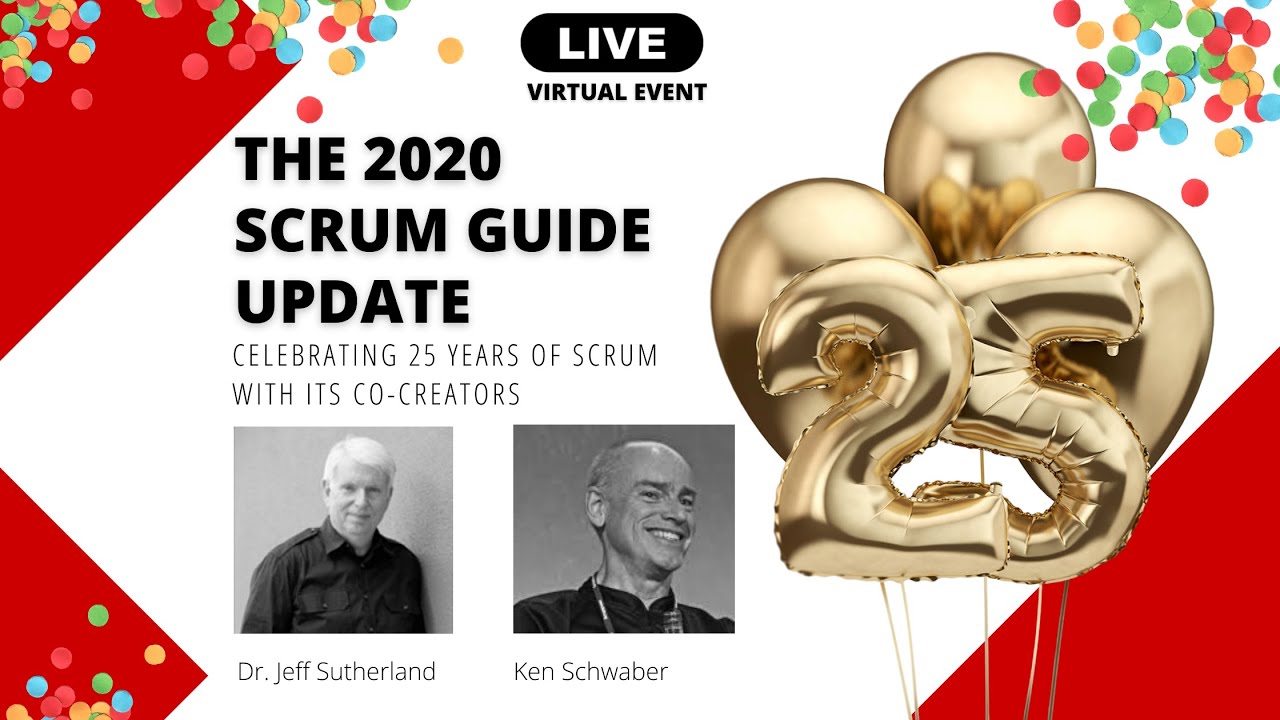
This afternoon, Wednesday 18th November, the latest version of the Scrum Guide1 has been released. The first update in over three years and there are quite a few changes. Scrum Inc. ran a 3-hour Zoom call2 to introduce the new guide, and here are a few of my takeaways from that call.
The first thing is that the guide has been reduced from 18 pages to 13. There were a lot of unclear descriptions around Product Backlog Items, Retro Items and Sprint cancellations that have all gone. This reduction appears to be an attempt to open up Scrum to a wider audience, not just IT projects, which was JJ Sutherland’s reiterated in his takeaway.
Don McGreal commented that by being Less Prescriptive (a term that came up a lot on the call)
it gives teams more freedom to be creative. He highlighted
the three questions3 which (were only a
suggested format for the daily scrum) have now been completely removed. Don suggested that there
are better ways to plan the day’s work, and saying that these questions were being weaponised by
project managers. Jeff Sutherland mentioned that he saw one team working with a single (although
two part) question:
- What is the most important item that needs to be done, and
- how will the whole team organise to make sure it gets completed - This is designed to emphasise swarming4.
The development team is no longer part of the guide. It has been replaced by developers. This highlights that there is only one team, the whole Scrum team, PO, SM and developers. Having a team within the team was seen to lead to them and us behaviour between the PO and developers. Now there is a single team, working towards a single Product Goal.
Which leads onto the next thing which is new for the 2020 version of the guide, a Product Goal. Jeff mentioned that he sees Product Owners, who have come from strong Project Management backgrounds viewing their work as delivering a collection of tasks (PBIs) in order to complete a project. Whereas the product is alive, changing, and the team needs to adapt in order to keep it relevant. Having a Product Goal is seen as a way to focus, and pull the right items from the Product Backlog.
There is more emphasis placed on commitments too, which is where the various scrum artifacts are now housed.
- The Product Backlog is the commitment to the Product Goal
- The Sprint Backlog is the commitment to the Sprint Goal, and for
- The Definition of Done is the commitment to the Product Increment.
The Scrum master is now explicitly given responsibilities. In the previous version the Scrum Master was described as being the servant leader. Many had put more emphasis on the servant part, responsible for promoting and supporting Scrum. With the new guide the Scrum Master is now made accountable for the team’s effectiveness. Scrum Masters are true leaders who serve the Scrum Team and the larger organization.
Self-organizing teams have now been replaced with self-managing teams. The feeling here was that by referring to the development team as self-organizing, developers selfishly chose what they worked on and how, without really having the end goal in mind. JJ commented that the focus should be on the goals, and not the work/effort that it takes to get there. Now with a single self-managed team it is envisioned that there will be more focus on the (newly added) Product Goal, as opposed to self-interests.
Finally, in prior versions of the guide, teams used Sprint planning to decide which Product Backlog Items were going into the next Sprint Backlog and how they should be implemented. With the new version a new first topic is inserted before the what and how, why. Why is this Sprint valuable? This helps the team define the Sprint Goal, and prioritising work once the Sprint is underway.
The session started off with Don McGreal (I think) saying that Scrum has not changed over the years, it’s just that Jeff and Ken are getting better at communicating their ideas, which is how the guide shrinks with each release. To Quote the Guide:
Scrum is a lightweight framework that helps people, teams and organizations generate value through adaptive solutions for complex problems.
- A Product Owner orders the work for a complex problem into a Product Backlog.
- The Scrum Team turns a selection of the work into an Increment of value during a Sprint.
- The Scrum Team and its stakeholders inspect the results and adjust for the next Sprint.
- Repeat