Return to Office is a topic that has been dividing opinions for the last few years. Therefore, I was excited to hear this come up as a topic on the Curiosity Shop podcast1 with Brené Brown2 and Adam Grant3. I’ve been loving their conversations and can highly recommend their show.

The discussion starts with quick agreement that very few people are using productivity as the reason for return-to-office. Brown then suggests that this discussion may be quite boring.
Brown brought a lot of research to the discussion and wanted to start with Nick Bloom’s article in Nature4, This states hybrid and fully in office showed no differences in productivity, performance review grade, promotion, learning, or innovation. Hybrid had a higher satisfaction rate.
She then continues by quoting Lynda Gratton’s three decades of workplace research saying that, “the productivity debate is largely fought with the wrong metrics”. Brown then continues to say, Gratton’s argument5 is that hybrid work is better understood as a job design option. The question isn’t where do people sit, but which tasks need which environment?
Organizational psychology
Grant enthusiastically agrees, saying that a key aspect of workplace design is around how interdependent are people in their jobs. He notes that there are three kinds of interdependence based on organizational psychology: Pooled, Sequential, and Reciprocal. As examples he relates these back to sports:
- Floor Gymnastics (pooled) - each member of the team has their own routines, their individual scores are then totalled.
- Relay race (sequential) - there needs to be some coordination around the baton handovers, but mostly people work independently.
- Basketball (reciprocal) - there are a lot of dynamics in play and the team benefits from a lot of time together.
At this point Brown asks for an example of the gymnastics, and Grant is quickly to respond with call center sales teams. Each person has their own customer list, but the team’s metrics are basically the sum of the individual’s metrics. Brown seems a little unsure of this, and later in the conversation their discussion comes back to call centers. Brown shared that she had worked in a call center and it was brutal. Grant agreed, saying he too had done some phone sales, and the support of the people around him was greatly appreciated after getting knocked back 19 times in a row.
Culture, creativity and mission
To make a case for in-person work, Brown pointed to three topics: culture, creativity and mission. Grant immediately pushes back on the creativity point. So, Brown then expands on these a little saying that, the evidence for in-person work becomes strongest around three interconnected organizational dynamics:
- weak tie innovation networks,
- tacit knowledge and cultural transmission and
- shared mission organizational identity.
Weak ties, Brown says, are “the hidden engine of creativity and innovation”. She defines Weak ties as the “connections with colleagues outside your immediate team [which] are the primary carriers of novel information, cross-disciplinary insight, and breakthrough ideas.”
Creative collisions
Grant then brought up some meta-analysis from Marcus Baer6 showing that you get more fresh ideas from people you don’t know well and don’t talk to every day. There is agreement that by having people in the same location you enable more of these weak tie interactions. Grant also reminds us that Steve Jobs intentionally placed bathrooms in the center of buildings so that employees from different departments would be forced to cross paths, something Grant described as creative collisions.
Grant then brings up three arguments against forcing these daily in person creative collisions:
- There is no reason we cannot structure these unstructured interactions in remote work. I like the use of liberating structures, but he mentions things like virtual coffee dates where you are set up with a random person in your organization.
- We don’t need to have constant “weak tie” stimulus. People need time to take away learnings, and integrate them into their own ideas to avoid falling into group think.
- There is some research on scientific teams working on breakthrough discoveries shows that until around 2010 colocated
teams were much more creative than remote teams. However, around 2010 that reversed and remote teams were the ones who
were massively more innovative. Here grant was able to point to two sub ideas:
- 20 years ago we didn’t have the tools we have now for sharing documents, communicating etc.
- Creative collisions with people in your building are great, but why not have creative collisions with the best people in your field, no matter where they sit?
Finally Brown asks how this connects with us on a human level? They agree that colocation part time is needed to build meaningful relationships, establish culture, and live experiences that become the stories that connect the mission and help people identify with the organization. This requires time in the same room, but does not need to be imposed five days a week. Grant says that, when we know what each other looks like and have built a relationship, you can still have great conversations over chat and Zoom, so it’s arbitrary to say all of the time needs to be in the same place.
Systemic thinking
Closing out this discussion, Brown asks what is driving leadership’s decisions around return-to-office, and introduces a systems theorist, Donella Meadows’7 Iceberg diagram8.
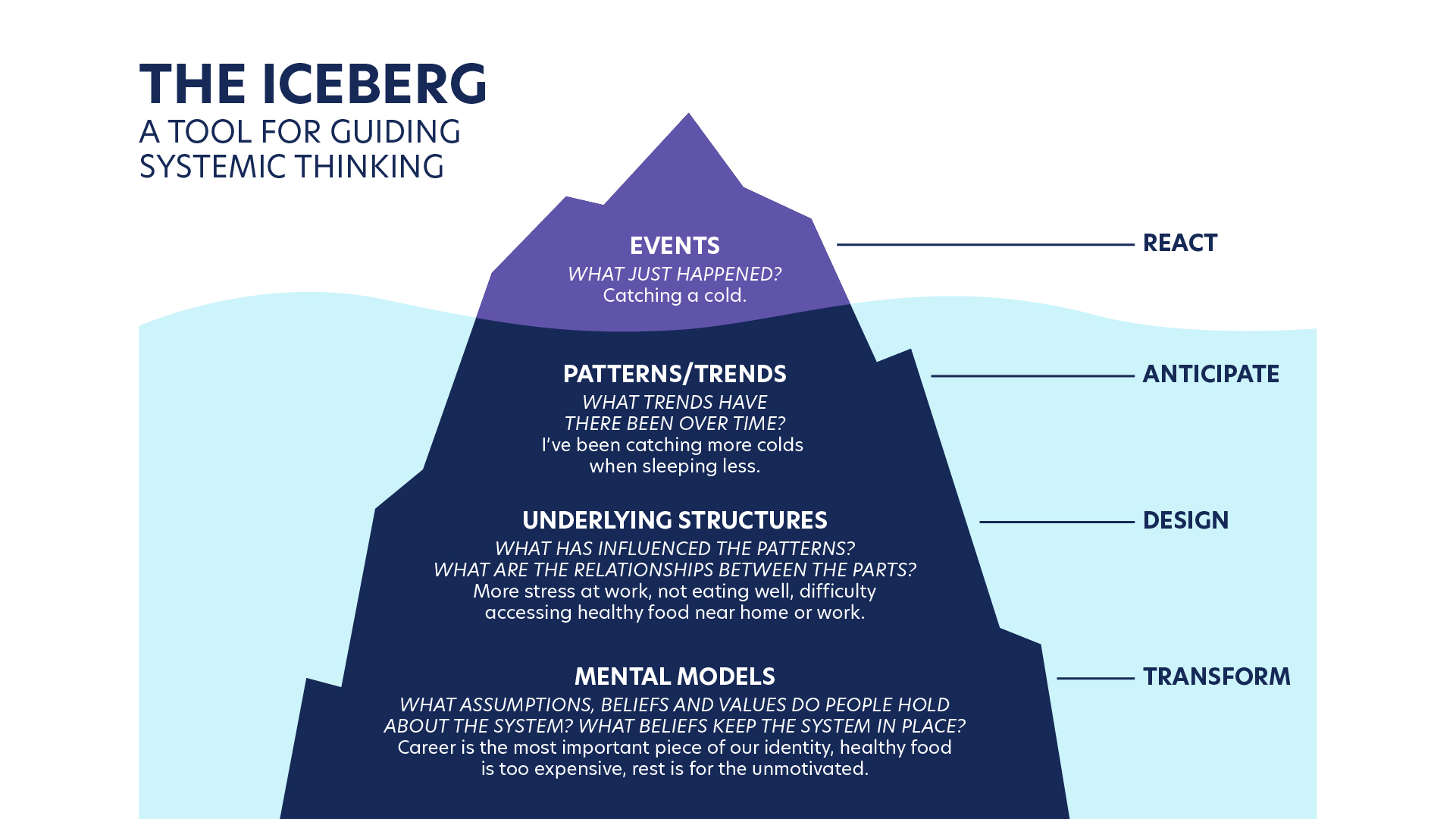
Most of the time leaders are just looking at the top of the iceberg when thinking about the question of return-to-office, should they be allowed to work remotely, or should they be hybrid. They are not getting under the surface, and asking what are the patterns and behaviours that they are seeing and would like to see? Then underneath that, what are the systems and structures that drive or support these behaviours? And even below that, at the deepest levels are the mental models. How are leaders thinking about work? These are the hidden assumptions that are deeply embedded in people’s minds.
Takeaways
Part of why I liked this podcast could be that the evidence based conclusions from Brown and Grant fit so well with my view of the world. For creative work I want to be standing at a whiteboard with people. For problem solving I want to be sat at a computer with a trusted partner. But when it comes to the delivery, pure grunt work, I prefer to be shut away without distractions.
Senior leadership states that by having people in the same location they will collaborate with one another. But this is not a strategy, it’s a hope. A lot of hope. As Sumeet Moghe, author of the Async-First playbook9 says. Hoping that two people get thirsty at the same time, and hoping that they go to the same coffee machine, and hoping that they strike up a conversation, and hoping that this sparks some new creative insight is a lot of hope - It’s not a strategy. Grant spoke about creating these unstructured interactions, and this is what leadership should be concentrating on.
Brown’s last point was that leaders need to challenge their mental models of how people work, and enable the structures that support them. Unfortunately that appear to be the exception rather than the norm.